Gemini API Pricing Tiers Explained: Standard, Batch, Flex, Priority and Contributor
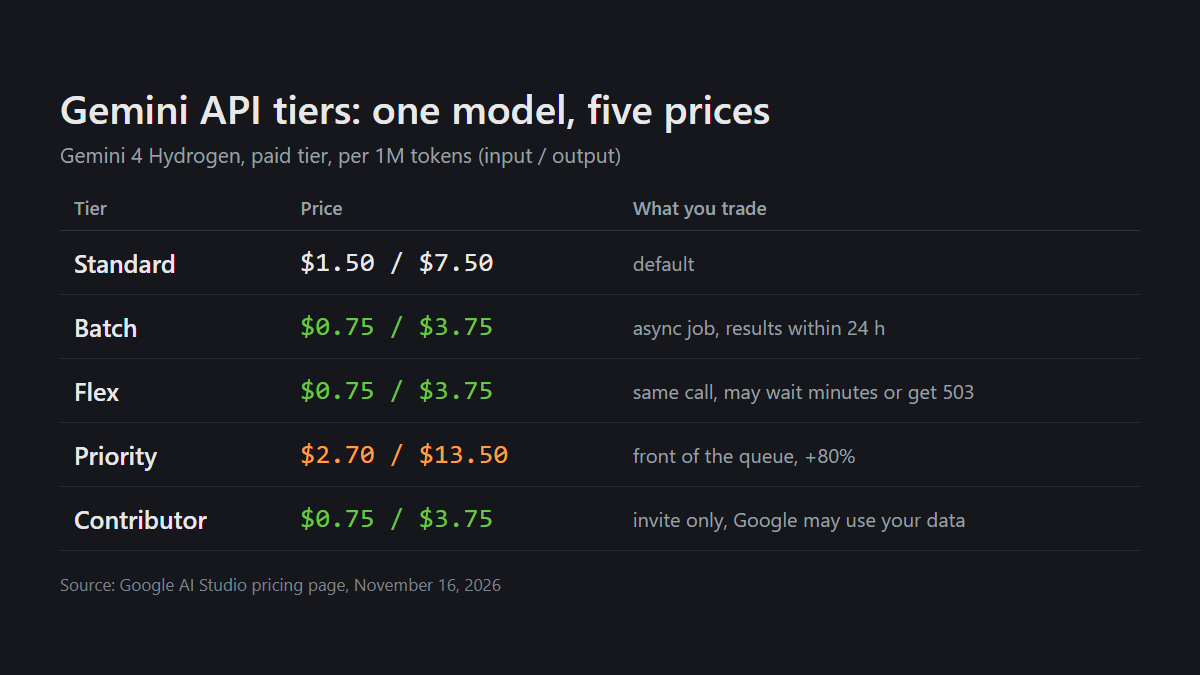
TL;DR: The Gemini API pricing page shows up to five tabs per model. They are the same model at different terms. Standard is the default. Batch and Flex cost half: Batch is asynchronous with a 24-hour target, Flex is a normal call that may wait in a queue or fail with 503 when Google is busy. Priority costs about 80% more and goes to the front of the queue. Contributor also costs about half, with Standard speed, but Google may use your prompts and outputs to improve its products, and it is invite-only. For Gemini 4 Hydrogen that is $1.50 / $7.50 per 1M input / output tokens on Standard, $0.75 / $3.75 on Batch, Flex and Contributor, and $2.70 / $13.50 on Priority.
The five tiers at a glance
| Tier | Price vs Standard | How you call it | Speed (Google's target) | When it can fail | Your data |
|---|---|---|---|---|---|
| Standard | full price | normal request, the default | seconds to minutes | usual errors | not used for training (paid tier) |
| Batch | −50% | separate asynchronous Batch API: you submit a job and collect results | up to 24 hours | the job expires after 48 hours if not done | not used for training (paid tier) |
| Flex | −50% | normal request with service_tier set to flex | minutes, 1–15 min target | 503 when capacity is short, no fallback | not used for training (paid tier) |
| Priority | +75% to +100% (we see +80% on every model) | normal request with service_tier set to priority | seconds | over its limit it quietly runs as Standard | not used for training (paid tier) |
| Contributor | up to −50% | invite-only, enabled per project | same as Standard | as Standard | used to improve Google products, human reviewers may read it |
Flex and Priority are marked "preview" in Google's documentation. The free tier is not one of these tabs: it is the left column inside each tab (see below).
Not to be confused with usage tiers. Google's billing page also talks about tiers: Free, Tier 1, Tier 2 and Tier 3. Those describe your account, not the price of a request. You move up by paying: Tier 1 needs a linked billing account, Tier 2 needs $100 paid and 3 days since the first payment, Tier 3 needs $1,000 and 30 days. The usage tier sets your rate limits and monthly spend cap ($250 on Tier 1, $2,000 on Tier 2). Every request still uses one of the five pricing tiers above.
Standard: the default price
The default for every request, the price Google advertises for each model. Nothing to switch on. On the paid tier, the pricing page marks Standard traffic as not used to improve Google's products.
Batch API: half price, results within 24 hours
You send many requests at once, either inline (under 20 MB in total) or as a JSONL file of up to 2 GB, and get a job ID back. Google's target is 24 hours, and its documentation says most jobs finish much sooner. A job that is still pending or running after 48 hours expires with no results, so very large jobs are better split. You can poll the job or let a webhook tell you when it is done. Batch has its own, larger rate limits.
Batch currently works only with the generateContent API, not with the newer Interactions API.
Good for: evaluations, processing a dataset, generating embeddings or images in bulk, anything where nobody is waiting for the answer.
Flex inference: half price, same code, but it may wait
Flex is a normal synchronous call with one extra field, so it suits work where each step needs the previous answer, like an agent working through a task, which Batch can't do. The catch is that Flex runs on spare capacity: when Standard traffic spikes, Flex requests can be held back or dropped.
Turning it on is one parameter. This is Google's own Python example from the Flex page, using the Interactions API:
from google import genai

client = genai.Client()

interaction = client.interactions.create(
model="gemini-4-hydrogen",
input="Analyze this dataset for trends...",
service_tier='flex'
)
print(interaction.output_text)
For Priority, the value is 'priority'. Leave the field out and the request runs on Standard.
What Google tells you to expect from Flex:
- Latency of minutes, with a target of 1 to 15. Google recommends a client timeout of 10 minutes or more.
- 503 Service Unavailable when capacity is short, and 429 for rate limits. You need your own retries with exponential backoff.
- No automatic upgrade. A Flex request is never moved to Standard behind your back, so you are never charged the full price by surprise.
- Same rate limits as Standard. Flex counts toward your normal limits and does not raise them.
Good for: background agents, nightly jobs, evaluations, research on a tight budget.
Priority inference: pay about 80% more, stay at the front
Priority requests go to the highest-priority queues and are never dropped to make room for other traffic. If you go over the Priority limit, the request is not rejected: it is processed as Standard and billed at the Standard price. The response header x-gemini-service-tier tells you which tier actually served it, so watch it if you pay for Priority.
By default the Priority limit is 0.3× your Standard rate limit for that model and tier, and it counts toward your overall limits. Google says Priority is available on the Interactions API endpoints.
Google's documentation gives the price as "75–100% more than Standard". On the pricing page every model that has a Priority tab is exactly 1.8× Standard (for example Hydrogen $2.70 vs $1.50 input).
Good for: customer-facing chat, copilots, real-time triage, anything with a service level to keep.
Contributor tier: half price in exchange for your data
The Contributor tier gives "up to 50% off token costs" with "the same real-time performance" as Standard. In exchange, data from that model in your project is used under the terms for Unpaid Services: Google may use your inputs and outputs to improve its products and machine learning, and those terms say human reviewers may read, annotate and process them. Google asks users not to send sensitive or personal information on this tier.
It is a private preview: Google invites eligible users by email and they see a callout in AI Studio. We have not been invited, so this section is based only on Google's documentation.
Which models have it. Our version tracker keeps a copy of the pricing page every time it changes, so we can see how this list has shrunk:
| Date (2026) | Change on the pricing page |
|---|---|
| Nov 4 (our first copy) | Contributor tab on Gemini 3.8 Flash, 3.5 Flash-Lite, 3.1 Pro Preview and 4 Argon |
| Nov 10 | added for Gemini 4 Carbon ($1.00 / $5.00) |
| Nov 11 | removed from Gemini 4 Carbon |
| Nov 12 | added for Gemini 4 Hydrogen |
| Nov 13 | removed from Gemini 3.8 Flash, 3.5 Flash-Lite and 3.1 Pro Preview |
Today only Gemini 4 Argon ($1.00 / $5.00) and Gemini 4 Hydrogen ($0.75 / $3.75) have it, and the Contributor section of Google's logs policy lists the same two models. For Argon, the Contributor price on the page carries no end date, while Argon's Standard price doubles on December 1, 2026 (see below). Whether the Contributor price stays at $1.00 / $5.00 after that, the page doesn't say.
Good for: cheap, fast calls on data you would be fine with Google reading: public text, synthetic tests, open benchmarks. Not for customer data.
Gemini 4 Hydrogen, Argon and Carbon prices on every tier
Per 1M tokens, input / output, paid tier, from Google's pricing page as of November 16, 2026. Output includes thinking tokens, which can be most of the output: see our Hydrogen thinking-level test.
| Model | Standard | Batch | Flex | Priority | Contributor |
|---|---|---|---|---|---|
| Gemini 4 Hydrogen | $1.50 / $7.50 | $0.75 / $3.75 | $0.75 / $3.75 | $2.70 / $13.50 | $0.75 / $3.75 |
| Gemini 4 Argon, until Nov 30 | $2.00 / $10.00 | $1.00 / $5.00 | $1.00 / $5.00 | $3.60 / $18.00 | $1.00 / $5.00 |
| Gemini 4 Argon, from Dec 1 | $4.00 / $20.00 | $2.00 / $10.00 | $2.00 / $10.00 | $7.20 / $36.00 | not stated |
| Gemini 4 Carbon, until Nov 30 | $2.00 / $10.00 | $1.00 / $5.00 | $1.00 / $5.00 | $3.60 / $18.00 | — |
| Gemini 4 Carbon, from Dec 1 | $4.00 / $20.00 | $2.00 / $10.00 | $2.00 / $10.00 | $7.20 / $36.00 | — |
| Gemini 3.8 Flash, until Dec 31 | $0.75 / $3.75 | $0.375 / $1.875 | $0.375 / $1.875 | $1.35 / $6.75 | — |
Gemini 3.8 Flash goes to Hydrogen's price ($1.50 / $7.50 on Standard) on January 1, 2027. Argon and Carbon are not on the free tier at all.
Which models have which tiers
Flex and Priority: Gemini 4 Carbon, Argon and Hydrogen; Gemini 3.8 Flash, 3.6 Flash, 3.5 Flash-Lite, 3.1 Flash-Lite, 3.1 Pro Preview, 3 Flash Preview; Gemini 2.5 Pro, 2.5 Flash and 2.5 Flash-Lite (Google's lists on the Flex and Priority pages). On the pricing page, Gemini 3.8 Flash TTS, 3.8 Flash-Lite TTS and Gemini 2.5 Flash Image also have Flex and Priority tabs.
Batch: all of the above, plus several image, speech and embedding models that have Standard and Batch only, such as Nano Banana 2.1, Gemini 3.1 Flash TTS Preview and Gemini Embedding.
Standard only: for example Gemini Omni 1.2 Flash, Gemini Decision 1, Gemini 3.5 Transcribe and Gemini 3 Pro Image.
Contributor: only Gemini 4 Argon and Hydrogen.
Is the free tier one of these tiers?
No. Each pricing tab has two columns: Free Tier and Paid Tier. The free tier means you use an API key without billing, with low rate limits: our free-tier key was cut off after 20 Hydrogen requests in a day, and 3.8 Flash had the same daily limit. The important difference is the row "Used to improve our products": Yes on the free tier, No on the paid tier, except in the Contributor tab, where it is Yes. So a free key shares your data with Google much as Contributor does; you just pay nothing and get far lower limits.
Batch and Flex are not available on the free tier for the Gemini 4 models.
What this means for you
- Someone is waiting for the answer: Standard. Priority only if slow or failed responses cost you more than 80% extra, and remember it falls back to Standard above 0.3× your limit.
- Nobody is waiting and requests are independent: Batch, half price.
- Nobody is waiting but each step needs the last one (agents, chains): Flex, half price, with a 10-minute timeout and retries.
- The data is not sensitive and you got the invite: Contributor gives half price at full speed for Argon and Hydrogen.
- Price watch: Argon and Carbon double on December 1, 2026, Gemini 3.8 Flash on January 1, 2027.
FAQ
Is Flex the same as Batch? Both cost half of Standard, but Flex is a normal synchronous call that answers in minutes, while Batch is a separate asynchronous job with a 24-hour target. Use Flex when each step depends on the previous answer.
How do I turn on Flex or Priority? Set service_tier to flex or priority in the request. Without the field, the request runs on Standard.
Does the Contributor tier use my data for training? Yes. Google uses it to improve its products and machine learning, and human reviewers may read it, so don't send sensitive or personal data.
What happens when I exceed the Priority limit? The extra requests run as Standard and are billed at the Standard price. The x-gemini-service-tier response header shows which tier served each request.
Can I use Flex or Batch on the free tier? Not for the Gemini 4 models: on their pricing tabs, Batch and Flex are marked "Not available" in the free column.
What we don't know
- How often Flex returns 503 or how long it really waits. Google gives only a target (1–15 minutes). We have not measured it yet.
- Whether the Contributor price for Argon changes on December 1. The page lists $1.00 / $5.00 with no date.
- Why Contributor was removed from four models in November. Google has not said; the page simply changed.
Read next
- Gemini 4 Hydrogen Is Out: In Antigravity on Google AI Pro, With a New Extra Thinking Level
- Gemini 4 Hydrogen vs 3.8 Flash on a Real Coding Task: Similar Score, Half the Quota
Sources: Google AI Studio documentation: Pricing, Optimization and inference, Flex inference, Priority inference, Batch API, Billing, Rate limits, Logs policy: Contributor Tier, Terms: Unpaid Services, all checked November 16, 2026; the dates in the Contributor history come from our version tracker's copies of the pricing page (November 4–16, 2026); free-tier limit from our own API tests (November 12, 2026).