Gemini 4 Hydrogen vs 3.8 Flash Tested: Every Thinking Level, max and Antigravity Quota
TL;DR: Gemini 4 Hydrogen was faster than Gemini 3.8 Flash at every thinking level and used fewer thinking tokens: a median of 8 seconds per task on Low against 21 for Flash. Every configuration solved all 24 of our tasks, so on tasks like these the level changes speed and cost, not the result.
- Extra (
xhigh) thought about 2.7 times as much as High and gained nothing here. - In the Gemini API,
"max"is an accepted value for Hydrogen, but it thought about as much ashigh, not more thanxhigh. - On the shared Antigravity quota of a Google AI Pro account, Hydrogen Medium used 1.6 times as much as 3.8 Flash Medium for the same 24 tasks, which is about what the two models' API prices predict.
Results: Hydrogen vs 3.8 Flash at every thinking level
The same 24 tasks with known answers, through the Antigravity CLI on a Google AI Pro account, one task per request, no tools (how we tested).
| Model and level | Correct | Median time | Median thinking tokens | Mean thinking tokens | API price of the 24 tasks |
|---|---|---|---|---|---|
| Hydrogen Low | 24/24 | 8.2 s | 944 | 1,808 | $0.76 |
| Hydrogen Medium | 24/24 | 11.2 s | 1,595 | 3,378 | $1.04 |
| Hydrogen High | 24/24 | 20.6 s | 2,157 | 5,175 | $1.35 |
Hydrogen Extra (xhigh) | 24/24 | 27.7 s | 5,730 | 11,244 | $2.49 |
| 3.8 Flash Low | 24/24 | 21.1 s | 1,439 | 2,604 | $0.46 |
| 3.8 Flash Medium | 24/24 | 26.4 s | 2,123 | 5,168 | $0.70 |
| 3.8 Flash High | 24/24 | 29.0 s | 3,369 | 8,795 | $1.05 |
Google AI Pro, Antigravity CLI 1.5.7, November 12, 2026, one run per level. Flash prices are the promotional ones; at the 2027 price the Flash column doubles.
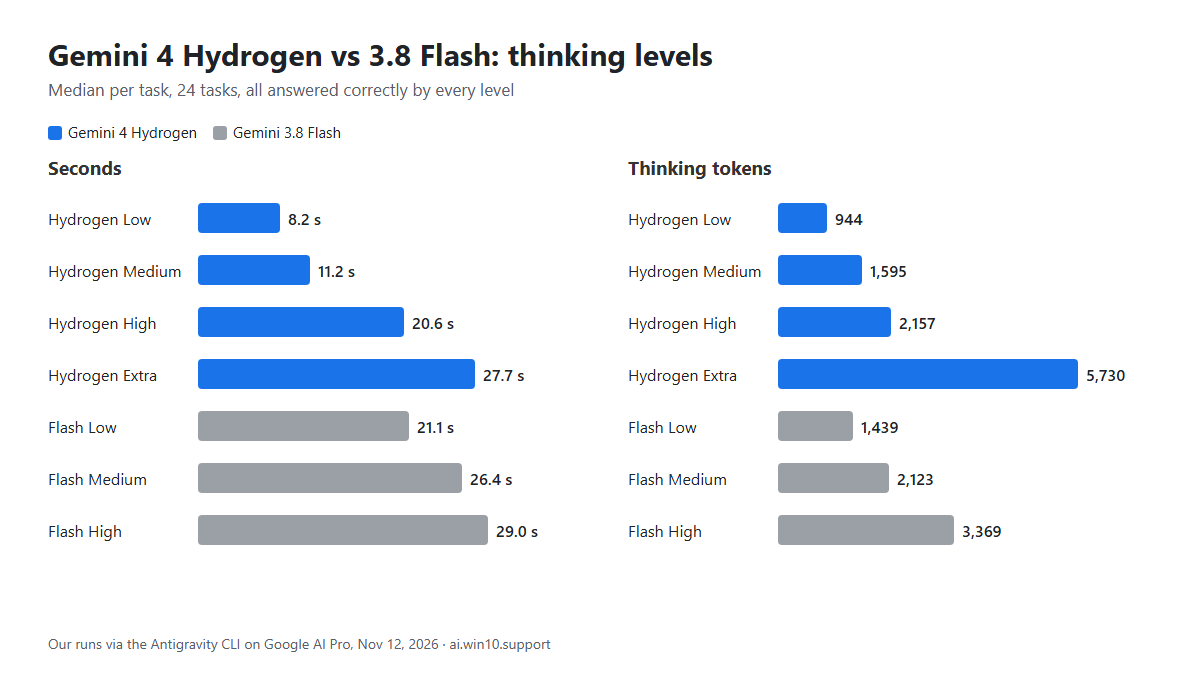
What stands out:
- Hydrogen is the faster model at every level. Hydrogen Low answered in a median of 8 seconds, 3.8 Flash Low in 21. Even Hydrogen High (20.6 s) was about as fast as Flash Low. On the 14 hard tasks alone the gap is wider: a median of 13 seconds for Hydrogen Low against 39 for Flash Low.
- Hydrogen thinks less at the same level name. Flash Medium's median of 2,123 thinking tokens is closer to Hydrogen High (2,157) than to Hydrogen Medium (1,595). So "Medium" on one model is not "Medium" on the other.
- Extra is a big step. Against High, Extra used 2.7 times the median thinking tokens and 2.2 times the mean. On the hard tasks the median went from 7,415 to 16,170, and the longest single answer used 48,083 thinking tokens. The API price of the run almost doubled ($1.35 → $2.49). On these tasks it bought nothing, because High was already right every time.
- Per token, Flash is still cheaper until the end of the year. With Flash at half Hydrogen's price, the Flash rows cost less than the matching Hydrogen rows even though Flash thinks more. From January 2027 both models cost the same per token, and then Hydrogen's shorter thinking makes it the cheaper one.
- Repeatable. We ran Hydrogen Medium again the next morning: a median of 10.2 seconds and 1,535 thinking tokens, against 11.2 and 1,595 the first time, again 24/24.
The honest limit of this test: the tasks were not hard enough to separate the levels by accuracy. All seven configurations got all 24 right. Quality on harder, longer work needs a different test; we are preparing one with real code.
How we tested
- Tasks: 24 short problems with one correct answer, generated by a script that also computes the answers, so nothing was graded by hand: 2 trivial (read a field from JSON, add three numbers), 8 medium (dates, weekdays, counting letters, a short Python program) and 14 hard (counting paths and binary strings, seating puzzles, shortest paths in a graph, a knapsack, counting subsets and permutations). Each prompt asks for the answer on a final
ANSWER:line, and we compare that line with the expected value. - Where: the Antigravity CLI (
agy) in print mode with JSON output, on our paid Google AI Pro account, one task per request. Version 1.5.7 on November 12, 1.5.8 on November 13. Every prompt starts with one line asking the model to answer from its own reasoning and not to run code or touch files, so we measure thinking, not tool use. All runs ended in one turn. - Levels: Hydrogen at
low,medium,highandxhigh(shown as Extra in the app's model menu; see what came with the Hydrogen release) and 3.8 Flash atlow,mediumandhigh. In the CLI the level is part of the model name, for examplegemini-4-hydrogen-xhigh;--model gemini-4-hydrogen --effort xhighdoes the same. - The Gemini API we used for one separate check, of the
maxvalue (below). - What we record: time per request, input, output and thinking tokens as
agyreports them, and the API price those tokens would cost: Hydrogen $1.50 / $7.50 per million input / output tokens, 3.8 Flash $0.75 / $3.75 (Google's promotional price until December 31, 2026; from January 1 it is $1.50 / $7.50) and Argon $2 / $10 (until November 30). Thinking tokens are billed as output.
Antigravity adds about 10,000 input tokens to every request
Each request through agy showed about 9,500–10,300 input tokens, even for "What is 48 + 37 - 15?". That is the agent's own instructions, sent with every request; a bare API call with the same question sends a few dozen tokens. For short tasks this fixed part is a large share of the cost: for the Hydrogen Low run, input was $0.37 of the $0.76.
This matters for any comparison of "the same model in Antigravity and in the API". The token counts are not the same even for the same prompt, so the cost of a task in the app is not simply the API price of your question and the answer.
Does thinkingLevel max work for Hydrogen in the Gemini API?
Google documents four thinking levels for Hydrogen: low, medium, high (the default) and xhigh. The Antigravity CLI refuses --effort max for Hydrogen and lists those four. The Gemini API, however, accepted "thinkingLevel": "max" with HTTP 200, so we checked whether it is a real value or an ignored one:
- A made-up value is rejected. The same request with
"thinkingLevel": "banana"returned HTTP 400 with an "invalid value" error for the thinking level. So the API knowsmax; it does not silently ignore unknown values. maxdoes not think more than Extra. On the five hardest tasks,maxused 4,751–11,631 thinking tokens and 20–45 seconds per answer;xhighused 15,363–27,360 thinking tokens and 60–105 seconds. All ten answers were correct.- It looks like High. On two tasks we also ran
high: 6,067 and 9,497 thinking tokens, against 4,751 and 8,247 formaxand 15,363 and 27,018 forxhigh.
| Task | high | max | xhigh |
|---|---|---|---|
| h04 (trace a Python program) | 6,067 tokens, 19 s | 4,751, 20 s | 15,363, 60 s |
| h10 (sum of a recursive sequence) | 9,497, 34 s | 8,247, 29 s | 27,018, 105 s |
Gemini API, generateContent, November 13, 2026. Thinking tokens as reported in the response's usage data.
Our reading, from seven tasks: for Hydrogen, max behaves roughly like high, not like a level above Extra. That is an inference, not something Google states; max is not in Hydrogen's documentation. If you want the deepest thinking from Hydrogen in the API, use xhigh.
Antigravity quota: Hydrogen vs 3.8 Flash vs Argon
In Antigravity on Google AI Pro, Hydrogen and 3.8 Flash share one quota pool; Gemini 4 Argon has its own. We ran the same 24 tasks once on Hydrogen Medium, once on 3.8 Flash Medium and once on Argon Medium, one batch at a time. Before and after each batch we waited until the remaining quota our account reported had not changed for two checks five minutes apart (at least 15 minutes after a batch), because the figure updates with a delay. Nothing else used the account during the runs.
| Batch (24 tasks, Medium) | Correct | Median time | Input / output tokens | API price | Quota used |
|---|---|---|---|---|---|
| Hydrogen | 24/24 | 10.2 s | 238k / 95k | $1.07 | 1.02% of the Flash pool |
| 3.8 Flash | 24/24 | 23.0 s | 231k / 133k | $0.67 | 0.64% of the Flash pool |
| Argon | 23/24 | 19.4 s | 230k / 49k | $0.95 | 6.33% of the Argon pool |
Google AI Pro, Antigravity CLI 1.5.8, November 13, 2026, one batch per model. "Quota used" is the drop in the remaining fraction of the weekly pool that our account reported, in percentage points.
- Hydrogen used 1.6 times the quota of 3.8 Flash for the same work, although it produced fewer tokens. Reddit threads on launch day ranged from "it barely moves" to "twice as expensive"; our measurement sits in between.
- The quota follows the API price. The Hydrogen batch would cost 1.6 times as much in the API ($1.07 against $0.67) and took 1.6 times as much quota (1.02% against 0.64%). Per dollar that is the same for both: 1.02 / 1.07 and 0.64 / 0.67 both come to 0.95 percentage points per dollar. Our guess is that the shared pool charges each model in proportion to its API price, with 3.8 Flash at its current promotional price. One batch per model is a small sample, and we don't know if this changes when the Flash promotion ends.
- Argon's numbers are not comparable with the other two: its pool has a different size, so 6.33% of it is not "six times more". Argon thought much less than the other two (a median of 400 thinking tokens) and was the only model with a wrong answer, on one subset-counting task (116 instead of 119).
What this means for you
- For everyday work, Hydrogen Low or Medium is the fast choice. In our runs both were two to three times faster than 3.8 Flash at the same level and just as accurate on short problems.
- Use Extra only when High isn't enough. It almost doubled the API price of our run, and in the API it took three times as long per hard task as
high. On problems that High already solves, you pay for nothing. - On a Pro plan, Hydrogen drains the shared pool faster than 3.8 Flash per task, about 1.6 times in our test. If you are close to the weekly limit and speed doesn't matter, Flash stretches it further, at least while its promotional price lasts.
- In the API, don't use
maxto get more thinking from Hydrogen. In our tests it behaved likehigh. Usexhigh. - Compare costs in the same place. Antigravity sends about 10,000 tokens of its own with every request, so the same question costs more there than a bare API call.
Read next
- Gemini 4 Hydrogen is out: in Antigravity on Google AI Pro, with a new Extra thinking level
- Antigravity subagents on Google AI Pro: the "pro" tier isn't Gemini 4 Argon
Sources: our own runs on a paid Google AI Pro account, November 12–13, 2026: the Antigravity CLI 1.5.7 and 1.5.8 in print mode with JSON output, the quota figures our account received from Antigravity before and after each batch, and Gemini API generateContent calls. Thinking levels and prices from Google AI Studio's Gemini 4 Hydrogen model page, thinking guide and pricing, and the Antigravity models page, read November 13, 2026. How we work: editorial policy.