Antigravity Is Building a Native Swarm Mode: What the agy CLI Binary Shows
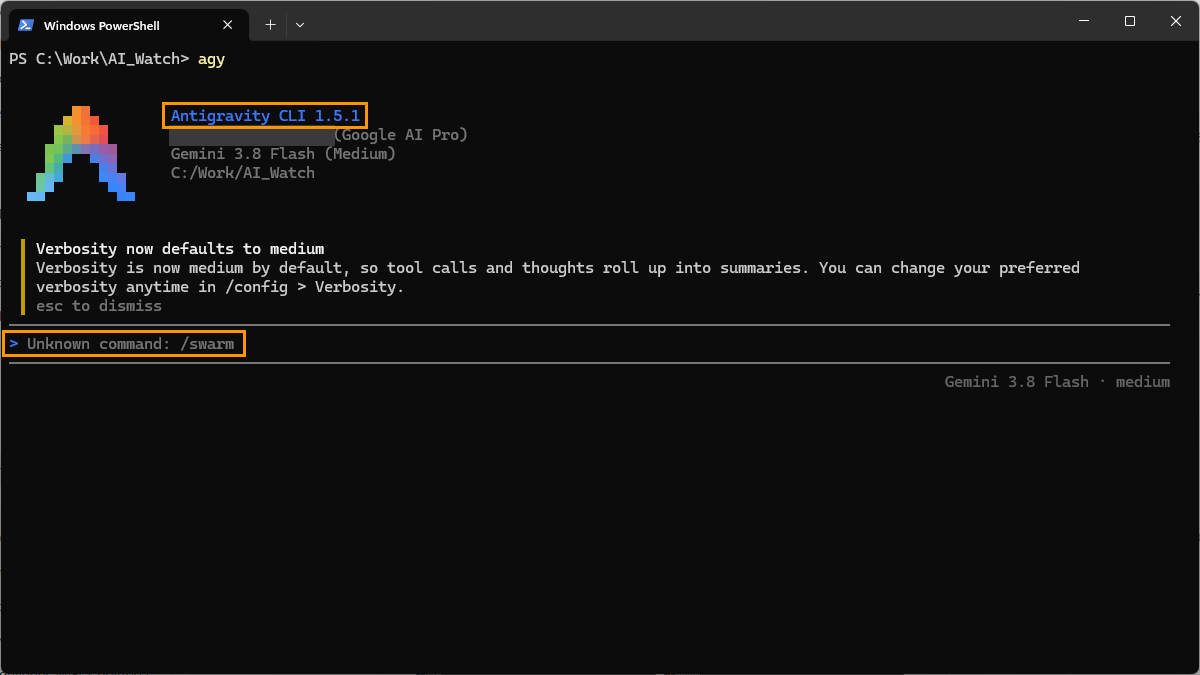
TL;DR: Google's Antigravity CLI (agy) has carried code for a native multi-agent swarm mode (/swarm) since version 1.3.4 (October 13, 2026), and the desktop app since 2.23.0. In 1.5.0 the code moved out of the experimental part of the codebase into the core, and it is still there in 1.5.1 (November 5). The text inside the binary describes a /swarm command: one conversation acts as the coordinator, adds named workers, each with its own brief and, optionally, its own model, and everyone shares a board you can open live. On our account the command is not available yet: both agy 1.5.0 and 1.5.1 answer Unknown command: /swarm. Nothing about it is in the official documentation or changelog. Everything below comes from strings in the binaries, which we read as bytes and did not run, so it describes what is built, not what Google has announced.
How we found it
We track every Antigravity CLI and app release and extract strings, Go package names and gRPC methods from the binaries, the same method we used to find Gemini 3.1 Ultra in agy 1.3.1 and the Gemini 4 Argon labels in app 2.23.0. A name in a binary is not a launched feature. The slash command swarm first appears in CLI 1.3.4 together with a group of Go packages named native_swarm: board, registry, wake and the main nativeswarm package. The app's server binary got the same packages in 2.23.0 (October 12).
In CLI 1.5.0 these packages moved from cortex/core/contrib/variants/native_swarm to cortex/core/native_swarm. In this codebase contrib/variants holds optional variants of the agent, so the move looks like the feature graduating from an experiment to a standard part of the agent. That is our reading of a path change, not a statement from Google.
How swarm differs from subagents and /teamwork
Antigravity already has documented multi-agent features. The subagents documentation describes background subagents that the main agent delegates to, the /agents panel for managing them, and /teamwork, which runs a team led by a "Project Orchestrator" through milestones with separate verification and is "available on paid plans". The word "swarm" appears on none of these pages (we read them on November 4, 2026). The only mention in the changelog is generic: Python SDK v0.1.22 (October 12) lets you give each subagent its own model, "enabling multi-tier or multi-provider agent swarms". That is an SDK option, not the /swarm command.
From the strings alone, swarm looks different in a few ways: you, not a planner, add each worker by name; every member can read the others' briefs; members share one board; and other conversations can join a running swarm by its ID. This is our reading of the binary, and it may change before launch.
What /swarm would do: coordinator, workers and models
The CLI's help text for the swarm tool lists its actions: status, models, add, model, kill, title, join. Strings around them explain each one. Our summary, with short quotes:
- A swarm starts when you add the first worker. Messages such as "no swarm yet; add a worker to start one" and "the coordinator creates it" show that the conversation you are in becomes the coordinator.
- Each worker gets a name and a brief. The code asks you to "name a worker after its job", and "Briefs are public: every member can read them."
- Workers can run on different models.
modelslists the models to choose from, and the text says that "with no model, a worker runs on your own model". There is a separate list of "suggested swarm models", andmodelswitches a waiting worker to another model while keeping its conversation. - Work is split into slices. Strings like "Assigned slice: %s..%s" and "%d worker(s)" suggest the coordinator hands each worker a part of the task.
- Killing is permanent. The text warns that
kill"ends a worker PERMANENTLY and deletes its own workspace", so the worker should push or upload its work first. - Other conversations can join.
/swarm jointakes a swarm ID, and errors such as "the swarm already has a member named %q" and "cross-project messaging is not allowed" show the limits. - Only the coordinator is in charge. Several actions fail with "only the coordinator may do this", and the coordinator itself "cannot be killed".
The live swarm board
The members share a board: there are packages board and board/filestore, a "swarm status" view with a "Dismiss finished swarm status" action, and a link that opens it in the app's side panel: sidecar://swarm/swarm_board/, described as "the live board". The CLI keyboard map has a swarm.board action and a "Kill Subagent" key.
The board can live in two places. One is local: errors mention a local board and "create swarm directory". The other is in the cloud: one error says a swarm's board "is in Spanner (%s), which this host cannot reach". Spanner is Google Cloud's database, which fits the cloud-based remote agents that Antigravity 2.29 started rolling out to Pro and Ultra subscribers on November 3. Our guess is that swarms will be able to span local and remote agents, but the code doesn't say that outright.
Is Antigravity swarm mode available yet?
On our Google AI Pro account the command doesn't exist yet. In agy 1.5.0 and 1.5.1, typing /swarm shows "No matches" in the command menu, and sending it returns Unknown command: /swarm.
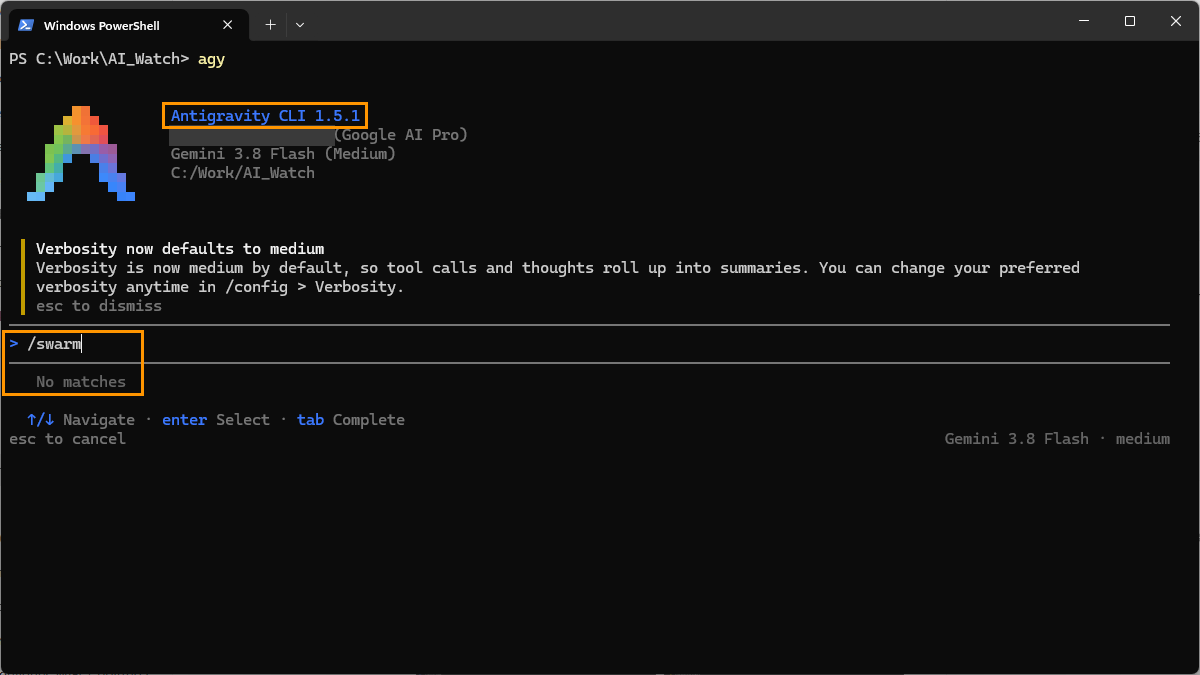
The binary explains why. One error message reads "%w on %s boards (… flag %s is off)", and there are configuration keys native-swarm-channels-local, native-swarm-channels-spanner and native-swarm-suggested-models. The feature is switched on from Google's side by a flag, the same way gradual rollouts work for other Antigravity features, such as Voice mode in 2.29. We don't know when the flag will be turned on, or for which plans. We also don't know how a swarm counts against your plan's limits. The code does fetch "model quota" for swarm workers, so each worker probably uses your quota like a regular conversation would.
What we don't know
- When swarm mode will launch, and whether it starts in the CLI, the app or both.
- Which plans get it, and how many workers a swarm allows.
- How the other multi-agent prompts in the binary relate to it. Next to
/teamworkroles, the binary has prompts for a "Swarm Orchestrator" and a worker that "Collaborates via blackboard to execute assigned swarm tasks". They may belong to/swarm, to Teamwork, or to an internal setup.
We will update this article when /swarm shows up in the changelog, the documentation or our own terminal.
How to check if /swarm is enabled in agy
Type /swarm in agy (version 1.5.0 or later). If it shows up in the command menu, the flag is on for your account. agy changelog lists the changes in your installed version; so far no entry mentions swarm.
Read next
- Antigravity IDE 2.6.0 now runs the agy CLI: why the agy CLI matters beyond the terminal
Sources: strings and Go package names read from the Antigravity CLI binaries 1.3.4–1.5.1 and the app's server binary from 2.23.0, without running them; subagents, Teamwork and changelog documentation, read November 4–5, 2026; our own agy 1.5.0 and 1.5.1 sessions on a Google AI Pro account. How we work: editorial policy.