The Periodic Table of Gemini: Model Picker Easter Egg, Nano Banana Clues, and Plan Tiers
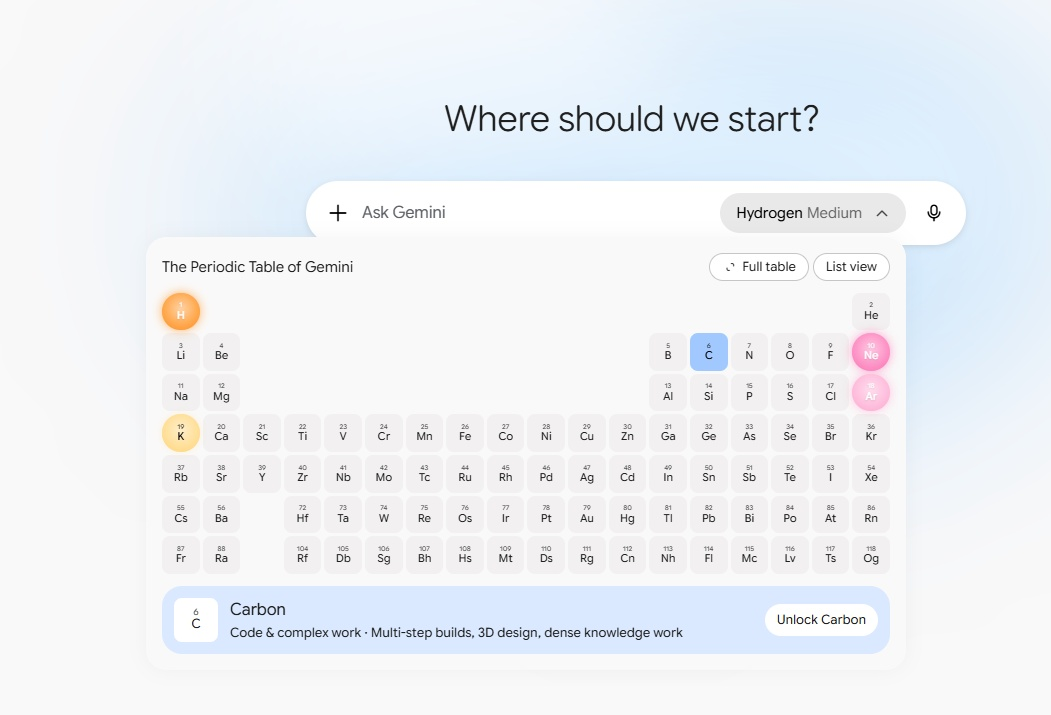
TL;DR: Pressing and holding the model selector button next to the prompt bar in the Gemini desktop web app (gemini.google.com) or Windows desktop app opens The Periodic Table of Gemini—an interactive 118-element Easter egg that works whether you are signed in or logged out. As you hold the button, it fills with a light-blue gradient like a progress bar (taking about a second), plays a sound, and switches into the table. It did not trigger in our test on the Android app or mobile web view. Five elements glow in the compact picker: Hydrogen (H), Carbon (C), and Neon (Ne) map to Gemini 4's active models, Argon (Ar) carries a retirement note pointing to Carbon, and Potassium (K) points to Niobium (Nb) in the full table, which triggers Try Nano Banana image generation. Model access still follows your subscription tier, showing Unlock prompts for higher-tier models.
On this page: Gemini 4 model elements · Nano Banana clue (K → Nb) · plan locks · how to open it · what this means for you · all 118 elements
How it works in the Gemini web and desktop apps
In our checks on November 27, 2026 (Windows 11, Chrome on gemini.google.com both signed in and logged out, plus the Gemini Windows desktop app), pressing and holding the model selector button next to the prompt bar (Hydrogen Medium) fills the pill with a light-blue gradient like a progress bar. After roughly a second, once the bar is full, Gemini plays a sound and replaces the standard model list with The Periodic Table of Gemini.
In our test on the Android app and in a mobile web viewport, the periodic table did not open. On mobile layouts, the model selector next to the prompt box disappears and a different model menu is shown at the top of the page—suggesting the Easter egg is only attached to the desktop prompt-bar button. Note also that while the periodic table triggers in non-English Gemini UI languages as well, the table's element names and descriptions always display in English.
The Easter egg has two views:
- Compact picker: Opens inline in place of the standard model menu, with Full table and List view buttons in the top-right corner.
- Full table modal: Clicking Full table opens a full-screen 118-element periodic table (including lanthanides and actinides) with keyboard arrow navigation, a Flip the element medallion interaction, and a bottom inspector card.
Which elements map to Gemini 4 models
Four elements in the periodic table map directly to Gemini 4 models—three active options and one retired:
| # | Element | Status | Description shown in the picker |
|---|---|---|---|
| 1 | H · Hydrogen | Active | Everyday help · Fast drafts, quick answers, and daily planning |
| 6 | C · Carbon | Active | Code & complex work · Multi-step builds, 3D design, dense knowledge work |
| 10 | Ne · Neon | Active | Deeper analysis · Strategy, research synthesis, and advanced reasoning |
| 18 | Ar · Argon | Replaced by Carbon | "Carbon replaced Argon, proving you don't need to be noble to get ahead." |
Other element names that often come up in Gemini model discussions—such as 2 · He (Helium) ("Sun-first gas"), 36 · Kr (Krypton) ("Meter standard"), and 54 · Xe (Xenon) ("Ion thrusters")—only show standard chemistry cards in the current table and do not select a model.
The Nano Banana clue: Potassium (K) and Niobium (Nb)
Besides the model elements, 19 · K (Potassium) glows yellow with a banana icon and the tagline Banana glow:
"Every banana is packed with K. Well, except for one. Find the other banana on here to see why."
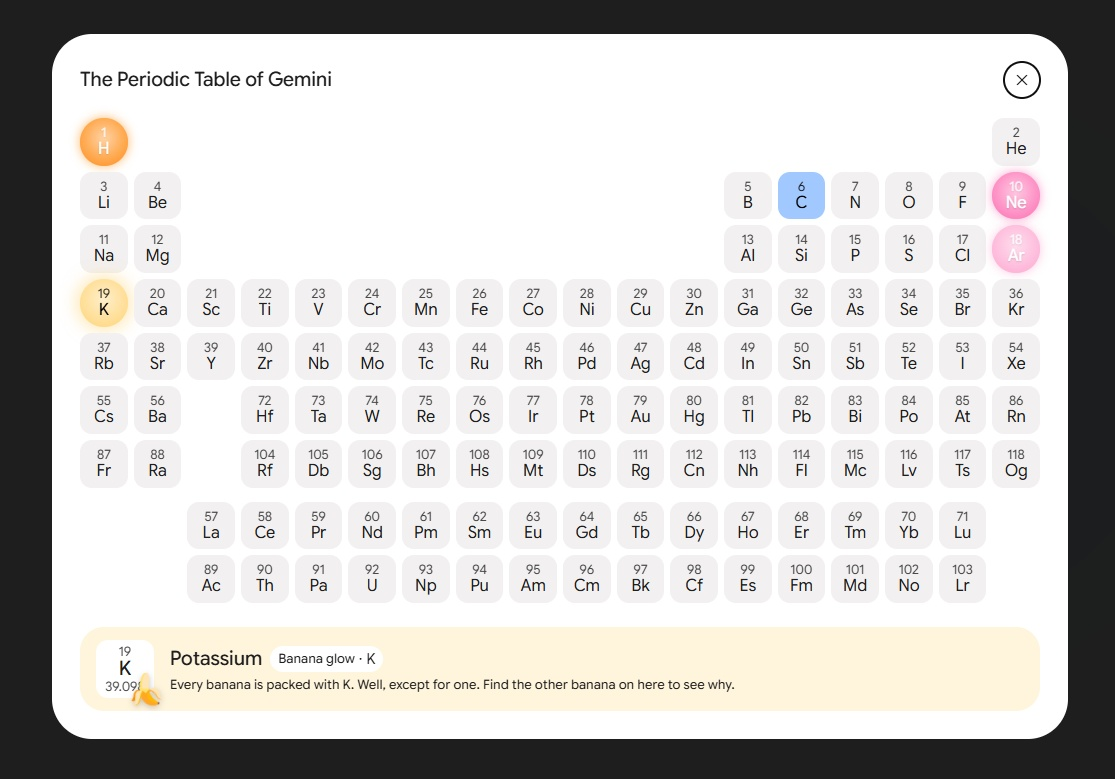
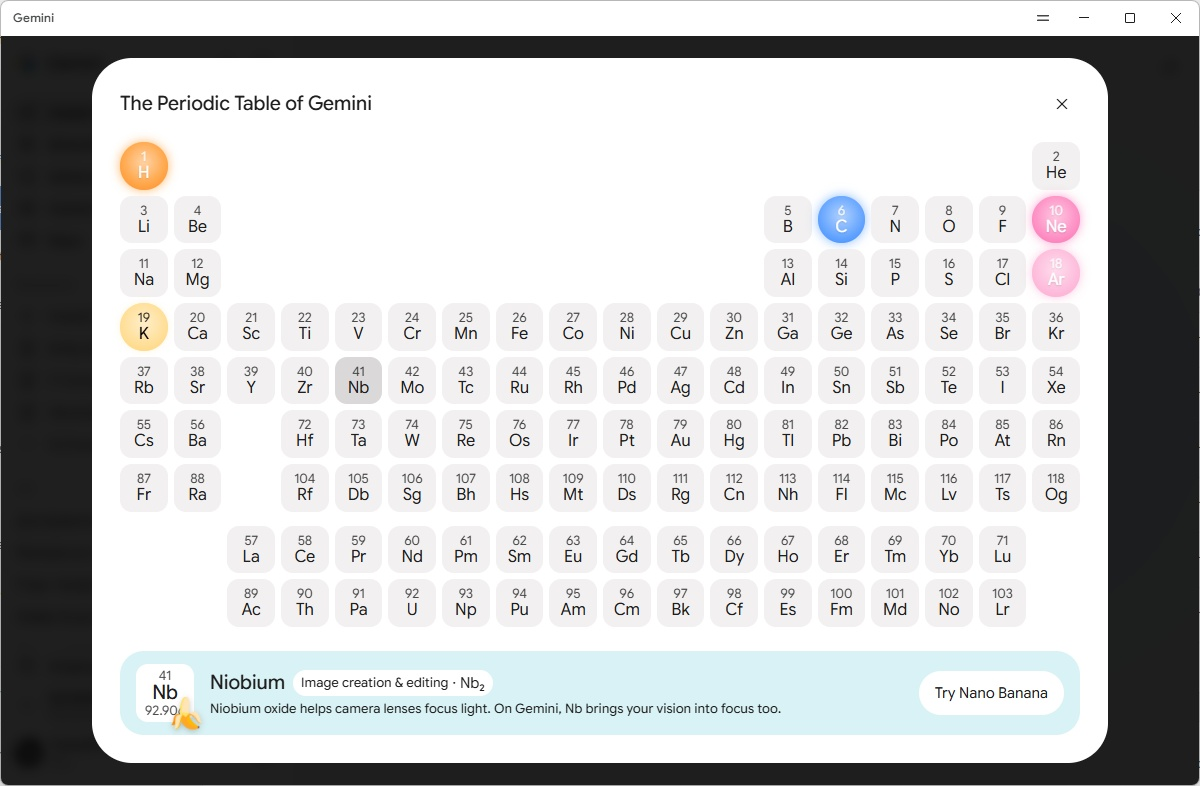
The second banana element in the full table is 41 · Nb (Niobium):
- Tagline / formula:
Image creation & editing(Nb₂) - Description: "Niobium oxide helps camera lenses focus light. On Gemini, Nb brings your vision into focus too."
- Action: Selecting it displays a Try Nano Banana button that switches Gemini into its image-generation mode.
Plan locks inside the periodic table
Depending on your Google AI subscription tier, selecting an active model element either switches to that model (Use ... / Switch to ...) or displays an Unlock ... prompt. In the current Gemini web release, the periodic table maps locked model elements per tier as follows:
| Plan tier | Locked model elements |
|---|---|
| Free | Hydrogen, Carbon, Neon |
| Google AI Plus | Carbon, Neon |
| Google AI Pro | Carbon |
| Google AI Ultra | None |
In our logged-out Chrome session, the prompt bar defaulted to Hydrogen Medium, and selecting Carbon in the periodic table displayed Unlock Carbon (we did not directly test signed-in Plus, Pro, or Ultra accounts inside the Easter egg). For Pro, locking only Carbon matches what the standard Gemini web picker offers in our Google AI plans and models matrix—where Pro includes 4 Hydrogen and 4 Neon, while 4 Carbon stays on Ultra.
How to open it yourself
- Open gemini.google.com on desktop (works both signed in and logged out) or the Gemini desktop app.
- Press and hold the model selector button next to Ask Gemini until the light-blue progress fill completes (about 1 second) and The Periodic Table of Gemini opens.
- Click H, C, Ne, Ar, or K in the compact picker, or click Full table in the top right to browse all 118 elements (including 41 · Nb).
What this means for you
- Fun UI shortcut, same plan rules: The periodic table lets you switch between Gemini 4 models or jump straight into Nano Banana image generation via Niobium (
Nb), but it does not unlock higher-tier models like Carbon outside your plan. - Confirmed retirement nod: Argon (
Ar) openly flags that Carbon replaced it, mirroring the standard Gemini web picker where4 Neonand4 Carbonhave superseded4 Argon. - No Helium, Krypton, or Xenon models here: Those tiles only carry general chemistry cards in this release.
Read next
- Google AI Plans and Gemini 4 Models: Neon, Hydrogen, Argon and Carbon
- Gemini 4 Neon Launches Across Antigravity, Gemini App, and API
- Gemini 4 Carbon Appears in Google AI Mode on Google AI Pro
All 118 elements in The Periodic Table of Gemini
Here is the full text of all 118 element cards shown in the full-table view—each with its atomic number, symbol, name, chemical formula, tagline, and one-line description. Notice that Argon (18 Ar), Potassium (19 K), and Niobium (41 Nb) carry custom Gemini or Nano Banana copy directly in the catalog below, while Hydrogen (1 H), Carbon (6 C), and Neon (10 Ne) keep standard chemistry cards here and show their model descriptions in the picker view above:
| # | Symbol | Element | Formula | Tagline | Description |
|---|---|---|---|---|---|
| 1 | H | Hydrogen | H₂CO₃ | Sparkling water | Powers every star in the sky — and gives sparkling water its crisp fizz. |
| 2 | He | Helium | He | Sun-first gas | Spotted in the Sun 27 years before Earth; never freezes at normal pressure. |
| 3 | Li | Lithium | LiCoO₂ | Phone battery | So light it floats on water — and powers phones, laptops, and EVs. |
| 4 | Be | Beryllium | Be₃Al₂Si₆O₁₈ | Emerald green | Forms emeralds and aquamarine, plus gold-coated space telescope mirrors. |
| 5 | B | Boron | B₂O₃ | Oven-safe glass | Helps borosilicate bakeware resist sudden heat swings in hot ovens. |
| 6 | C | Carbon | C₈H₁₀N₄O₂ | Caffeine | Builds diamonds, pencil lead, and the caffeine powering your morning. |
| 7 | N | Nitrogen | N₂ | Air & snack bags | Makes up 78% of Earth's air and keeps packaged snacks crisp and fresh. |
| 8 | O | Oxygen | O₂ | Liquid oxygen | Liquid oxygen is sky-blue and hovers between the poles of a strong magnet. |
| 9 | F | Fluorine | NaF | Toothpaste enamel | Hardens tooth enamel against acid and coats non-stick cookware. |
| 10 | Ne | Neon | Ne | Classic diner sign | Real neon tubes only glow electric red-orange — other colors use other gases. |
| 11 | Na | Sodium | Na₃C₆H₅O₇ | Nacho cheese melt | Sodium citrate is the secret that keeps melted nacho cheese ultra-silky. |
| 12 | Mg | Magnesium | C₅₅H₇₂MgN₄O₅ | Leaf green | Sits at the center of chlorophyll, making plants green, and sparks white. |
| 13 | Al | Aluminum | Al | Soda cans | Once pricier than gold — 19th-century royalty served VIPs on aluminum. |
| 14 | Si | Silicon | SiO₂ | Beach sand & chips | Ordinary beach sand and the microchip running this app share one element. |
| 15 | P | Phosphorus | P | Matchbox strip | Lights the strike strip on safety matchboxes and forms the backbone of DNA. |
| 16 | S | Sulfur | C₆H₁₀OS₂ | Garlic & onions | Gives chopped onions their bite, garlic its kick, and rubber its snap. |
| 17 | Cl | Chlorine | NaCl | Table salt | A stinging green gas on its own, yet with sodium it becomes table salt. |
| 18 | Ar | Argon | Ar | Museum preservation | Carbon replaced Argon, proving you don’t need to be noble to get ahead. |
| 19 | K | Potassium | K | Banana glow | Every banana is packed with K. Well, except for one. Find the other banana on here to see why. |
| 20 | Ca | Calcium | CaCO₃ | Seashells & chalk | Builds coral reefs, pearls, eggshells, chalk, and every bone in your body. |
| 21 | Sc | Scandium | Al-Sc | Lightweight alloys | A pinch of scandium makes aluminum baseball bats and bike frames lighter. |
| 22 | Ti | Titanium | TiO₂ | Bright white pigment | Titanium dioxide is the white pigment in sunscreen, paint, and toothpaste. |
| 23 | V | Vanadium | V₂O₅ | Colorful oxides | Named for Norse goddess Vanadis — compounds shift yellow, blue, green, violet. |
| 24 | Cr | Chromium | Al₂O₃:Cr³⁺ | Ruby red | A trace of chromium turns clear corundum into rubies and shines chrome bumpers. |
| 25 | Mn | Manganese | MnO₂ | Cave art & batteries | Used in 17,000-year-old cave paintings and still powers AA alkaline batteries. |
| 26 | Fe | Iron | Fe₂O₃ | Rusty Mars | Forges Earth's core, builds steel bridges, and gives rusty Mars its red. |
| 27 | Co | Cobalt | CoAl₂O₄ | Cobalt blue glass | Named after German 'kobold' goblins — creates the deepest blue stained glass. |
| 28 | Ni | Nickel | Cu₇₅Ni₂₅ | US 5¢ coin | A US nickel is 75% copper and 25% nickel — yet nickel makes it silvery. |
| 29 | Cu | Copper | Cu₄SO₄(OH)₆ | Statue of Liberty | The Statue of Liberty started penny-brown and took 30 years to turn mint green. |
| 30 | Zn | Zinc | ZnO | Mineral sunscreen | Mineral UV blocker in sunscreen — and 97.5% of modern US pennies. |
| 31 | Ga | Gallium | Ga | Melts in your hand | Solid at room temp, yet melts at 29.8°C — right in the warmth of your hand. |
| 32 | Ge | Germanium | Ge | First transistor | Powered the very first transistor in 1947 and vintage guitar fuzz pedals. |
| 33 | As | Arsenic | GaAs | High-speed LEDs | As gallium arsenide, it powers smartphone wireless chips and red lasers. |
| 34 | Se | Selenium | Se | Light sensor | Conducts electricity in light — the secret behind early photocopiers. |
| 35 | Br | Bromine | Br₂ | Liquid nonmetal | One of only two elements liquid at room temperature (the other is mercury). |
| 36 | Kr | Krypton | Kr | Meter standard | Greek for 'the hidden one' — its spectral glow once defined the meter. |
| 37 | Rb | Rubidium | RbNO₃ | Purple fireworks | Gives fireworks a vivid violet burst and runs compact GPS atomic clocks. |
| 38 | Sr | Strontium | SrCO₃ | Crimson fireworks | Gives red fireworks and roadside emergency flares their blazing crimson glow. |
| 39 | Y | Yttrium | Y₃Al₅O₁₂ | White LEDs | Named after tiny Ytterby, Sweden — helps phosphor coatings make white LEDs. |
| 40 | Zr | Zirconium | ZrO₂ | Cubic zirconia | Sparkles like diamond, cuts like ceramic knives, and survives jet engines. |
| 41 | Nb | Niobium | Nb₂ | Image creation & editing | Niobium oxide helps camera lenses focus light. On Gemini, Nb brings your vision into focus too. |
| 42 | Mo | Molybdenum | MoS₂ | High-heat lubricant | Won't melt until 2,623°C — used in rocket nozzles and high-heat lubricants. |
| 43 | Tc | Technetium | ⁹⁹ᵐTc | First synthetic | First element made artificially — now used in millions of heart scans yearly. |
| 44 | Ru | Ruthenium | Ru | Fountain pen tips | A tiny bead of ultra-hard ruthenium lets fountain pen nibs glide for decades. |
| 45 | Rh | Rhodium | Rh | White gold shine | One of Earth's rarest, most reflective metals — gives white gold its mirror shine. |
| 46 | Pd | Palladium | PdHₓ | Hydrogen sponge | Soaks up 900 times its own volume of hydrogen gas like a metallic sponge. |
| 47 | Ag | Silver | Ag | Best conductor | Best electrical and thermal conductor of any metal — reflects 95% of light. |
| 48 | Cd | Cadmium | CdS | Painter's yellow | Gave 19th-century oil painters their blazing yellow and red pigments. |
| 49 | In | Indium | In₂O₃·SnO₂ | Touchscreens | Transparent indium tin oxide lets your touchscreen sense your touch. |
| 50 | Sn | Tin | CuSn | Bronze age | Just 12% tin in copper launched the Bronze Age — Latin 'stannum' gives Sn. |
| 51 | Sb | Antimony | Pb-Sb | Lead-acid batteries | Hardens the lead grids inside car batteries; Sb comes from Latin ‘stibium’. |
| 52 | Te | Tellurium | CdTe | Solar panels | Rarer than gold on Earth, common in space — powers thin-film solar panels. |
| 53 | I | Iodine | I₂ | Violet vapor | Sublimes from black crystals to purple gas and turns starchy potatoes blue. |
| 54 | Xe | Xenon | Xe | Ion thrusters | So dense a xenon balloon sinks — deep-space probes fire blue xenon ions. |
| 55 | Cs | Cesium | ¹³³Cs | Atomic second | 9,192,631,770 ticks of a cesium-133 atom officially define one second. |
| 56 | Ba | Barium | Ba(NO₃)₂ | Green fireworks | Creates the brightest emerald-green bursts in celebration fireworks. |
| 57 | La | Lanthanum | La₂O₃ | Camera lenses | High-end camera glass adds lanthanum oxide to bend light without color fringing. |
| 58 | Ce | Cerium | Fe-Ce | Lighter flint | Every flick of a pocket lighter sparks tiny cerium alloy shavings at 1,600°C. |
| 59 | Pr | Praseodymium | Pr₆O₁₁ | Welder's goggles | Tints glassblower and welder goggles to filter out blinding yellow sodium glare. |
| 60 | Nd | Neodymium | Nd₂Fe₁₄B | Earbud magnets | Powers Earth's strongest permanent magnets — in earbuds, speakers, and motors. |
| 61 | Pm | Promethium | ¹⁴⁷Pm | Luminous paint | Glows faintly in the dark — once powered luminous spacecraft instrument switches. |
| 62 | Sm | Samarium | SmCo₅ | Guitar pickups | Samarium-cobalt magnets keep working at scorching heat where others fail. |
| 63 | Eu | Europium | Eu³⁺ | Banknote UV ink | Makes anti-counterfeit fibers in modern banknotes glow red under UV light. |
| 64 | Gd | Gadolinium | Gd³⁺ | MRI contrast | Loses magnetism right around room temp (20°C) and sharpens medical MRI scans. |
| 65 | Tb | Terbium | Tb³⁺ | Emerald phosphor | Glows electric laser-green under UV light and helps phone speakers vibrate. |
| 66 | Dy | Dysprosium | Dy | EV motor heat | Greek for 'hard to get' — keeps EV motor magnets strong at blazing heat. |
| 67 | Ho | Holmium | Ho | Magnetic record | Highest magnetic strength of any natural element, used in lab magnets. |
| 68 | Er | Erbium | Er³⁺ | Fiber-optic internet | Boosts light pulses across undersea fiber-optic cables — and tints glass pink. |
| 69 | Tm | Thulium | Tm | Portable X-rays | One of the rarest rare earths — powers surgical lasers and portable X-rays. |
| 70 | Yb | Ytterbium | Yb | Optical clocks | Optical lattice clocks that won't lose a single second in the universe's age. |
| 71 | Lu | Lutetium | Lu₂SiO₅ | PET scanners | Named after ancient Paris (Lutetia) — detects gamma rays in hospital PET scans. |
| 72 | Hf | Hafnium | HfO₂ | Tiny CPU gates | Atom-thin hafnium oxide stops electrons from leaking inside modern CPUs. |
| 73 | Ta | Tantalum | Ta₂O₅ | Phone capacitors | Resists corrosion and most acids — used in tiny smartphone capacitors. |
| 74 | W | Tungsten | W | Highest melting point | Melts at 3,422°C — highest of any pure metal, ideal for classic lightbulbs. |
| 75 | Re | Rhenium | Ni-Re | Jet turbine blades | Last stable natural element found (1925) — keeps jet turbine blades rigid. |
| 76 | Os | Osmium | Os | Densest element | Twice as dense as lead — a solid osmium brick would weigh over 50 pounds. |
| 77 | Ir | Iridium | Ir | Dinosaur asteroid | A worldwide iridium-rich rock layer points to the dinosaur-ending asteroid. |
| 78 | Pt | Platinum | Pt | Ultra-rare metal | All the platinum ever mined would barely fill a single small house. |
| 79 | Au | Gold | Au | Neutron star dust | Forged in colliding neutron stars — 1 gram hammers into a 1 m² translucent sheet. |
| 80 | Hg | Mercury | Hg | Liquid silver | Only metal liquid at room temp — so dense an iron cannonball floats on it. |
| 81 | Tl | Thallium | Tl | Green spectral line | Named after Greek 'thallos' (green shoot) for its vivid emerald spectral line. |
| 82 | Pb | Lead | Pb | Plumbing roots | Latin 'plumbum' gives both its symbol Pb and the English word 'plumbing'. |
| 83 | Bi | Bismuth | Bi | Rainbow crystals | Grows into iridescent rainbow crystals with geometric stair-step edges. |
| 84 | Po | Polonium | Po | Rare radioactive | First isolated from pitchblende ore in 1898 and named after Poland. |
| 85 | At | Astatine | At | Rarest on Earth | Less than 25 grams of natural astatine exist in Earth's crust at any moment. |
| 86 | Rn | Radon | Rn | Heavy noble gas | Nearly 8× heavier than air — a colorless noble gas seeping from granite. |
| 87 | Fr | Francium | Fr | 22-minute life | Most unstable of the first 101 elements — half vanishes every 22 minutes. |
| 88 | Ra | Radium | Ra | Vintage watch dials | Glowed green on 1920s watch dials before safer pigments replaced it. |
| 89 | Ac | Actinium | Ac | Blue darkroom glow | So radioactive it ionizes nearby air into an eerie pale-blue halo. |
| 90 | Th | Thorium | ThO₂ | Camping lanterns | Named after Thor — once made vintage camping lantern mantles glow white. |
| 91 | Pa | Protactinium | ²³¹Pa | Deep-sea clock | Trace protactinium in seafloor mud helps map ancient Ice Age ocean currents. |
| 92 | U | Uranium | UO₂ | Uranium glass | Once gave antique glass a bright green UV glow and vintage ceramics vivid red. |
| 93 | Np | Neptunium | Np | Beyond uranium | Named after Neptune right past Uranium — first transuranium element made. |
| 94 | Pu | Plutonium | ²³⁸PuO₂ | Deep-space battery | Warm plutonium-238 pellets power deep-space probes billions of miles away. |
| 95 | Am | Americium | ²⁴¹Am | Smoke detector | A tiny speck inside hallway smoke detectors senses smoke before you smell it. |
| 96 | Cm | Curium | ²⁴⁴Cm | Mars rover eye | Mars rovers use curium spectrometers to read the chemistry of Martian rocks. |
| 97 | Bk | Berkelium | Bk | Lab-made actinide | First synthesized in 1949 in California — used to create element 117. |
| 98 | Cf | Californium | ²⁵²Cf | Golden State atom | Named after California — emits neutrons used to scan bridge steel for cracks. |
| 99 | Es | Einsteinium | Es | Blue-glowing atom | Glows bright blue in the dark from its own radiation; first found in 1952. |
| 100 | Fm | Fermium | Fm | Element #100 | Marks the 100th step of the periodic table — first spotted in 1952. |
| 101 | Md | Mendelevium | Md | Table milestone | Honors the 1869 periodic table that predicted undiscovered elements. |
| 102 | No | Nobelium | No | Accelerator atom | Synthetic actinide only ever made a few atoms at a time inside accelerators. |
| 103 | Lr | Lawrencium | Lr | Cyclotron pioneer | Closes the actinide row — created inside particle accelerators in 1961. |
| 104 | Rf | Rutherfordium | Rf | Superheavy start | First transactinide element — marks the start of the superheavy row. |
| 105 | Db | Dubnium | Db | Lab namesake | Named after Dubna, the research city where many superheavy atoms were made. |
| 106 | Sg | Seaborgium | Sg | Superheavy tungsten | Superheavy element that behaves like an ultra-dense cousin of tungsten. |
| 107 | Bh | Bohrium | Bh | Quantum shells | Superheavy element honoring the quantum model of atomic spectral lines. |
| 108 | Hs | Hassium | Hs | Superheavy osmium | Named after Hesse, Germany — behaves like a superheavy cousin of osmium. |
| 109 | Mt | Meitnerium | Mt | Fission pioneer | Superheavy synthetic metal named in honor of nuclear fission research. |
| 110 | Ds | Darmstadtium | Ds | Heavy platinum | Created in Darmstadt, Germany by smashing nickel-62 into lead-208. |
| 111 | Rg | Roentgenium | Rg | X-ray tribute | Superheavy cousin of gold, named to commemorate the 1895 discovery of X-rays. |
| 112 | Cn | Copernicium | Cn | Relativistic atom | Relativistic physics makes its electrons act so oddly it may be a gas. |
| 113 | Nh | Nihonium | Nh | Named for Japan | First element discovered in Asia — named after Nihon (Japan) in 2016. |
| 114 | Fl | Flerovium | Fl | Island of stability | Sits near the fabled 'island of stability' for longer-lived superheavy atoms. |
| 115 | Mc | Moscovium | Mc | Blink-and-miss | Exists for only a fraction of a second before decaying down into nihonium. |
| 116 | Lv | Livermorium | Lv | Superheavy chalcogen | Synthetic superheavy element created by fusing calcium and curium atoms. |
| 117 | Ts | Tennessine | Ts | Superheavy halogen | Second-heaviest known element — made by colliding calcium into berkelium. |
| 118 | Og | Oganesson | Og | Final frontier | Element #118, the heaviest known atom — each lasts less than a millisecond. |
Sources: our own tests in the Gemini web app (gemini.google.com, signed in and logged out), Gemini Windows desktop app, and Android app (Nov 27, 2026), along with the text and tier settings shipped in the current Gemini web release (gemini.google.com). How we work: editorial policy.